
Rotobrush Air Duct Cleaning in St. Petersburg: A Homeowner’s Guide
Most duct cleaning methods push air through your ducts. Rotobrush puts a rotating brush inside them, and that distinction explains why two companies can charge the same price and produce completely different results. In St. Petersburg’s humid climate, caked debris and biofilm cling to duct walls in ways that air alone won’t dislodge. This guide explains exactly what Rotobrush does mechanically, where it works well in Florida homes, and what it honestly can’t fix on its own.
If you’d rather not spend your afternoon sorting through equipment claims, call (855) 967-4983 and we’ll walk you through what a real Rotobrush job involves.
Key Takeaways
- Rotobrush is a contact-cleaning system: a rotating brush scrubs duct walls while a HEPA vacuum extracts debris at the same time.
- Air-whip and blowout methods can stir up what’s already settled without removing it from the system.
- Florida flex duct requires careful technique. The wrong brush pressure or RPM can tear the inner liner.
- Rotobrush is the core of the job, but some homes also need duct repair, sealing, or IAQ treatment to finish it properly.
- You can verify the equipment yourself: ask for the pre- and post-cleaning camera footage before you pay.
How Does the Rotobrush System Actually Work?
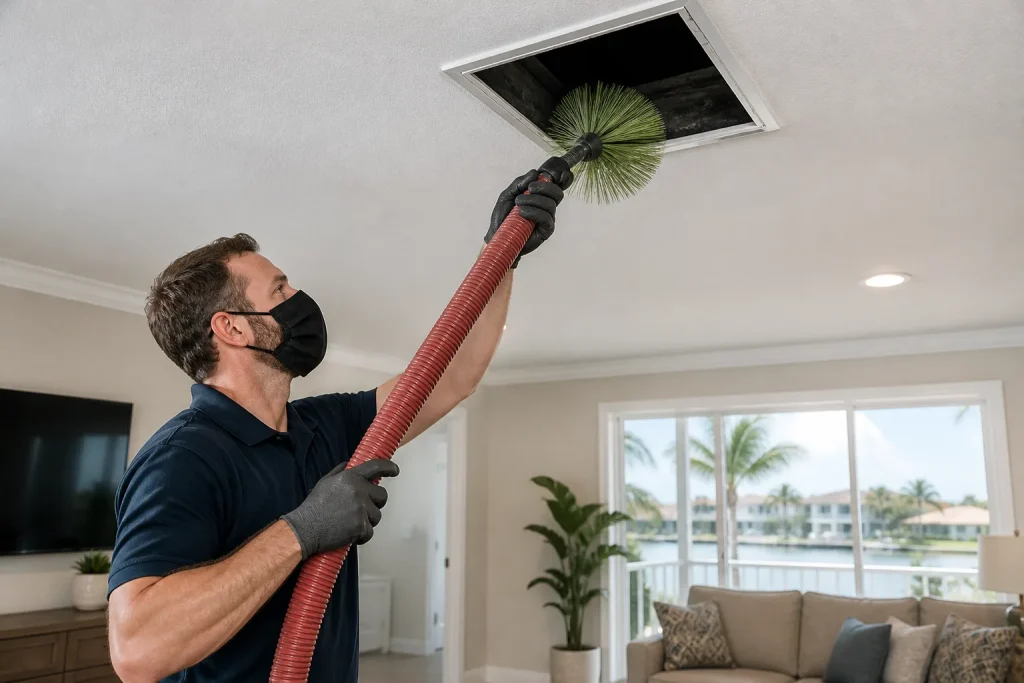
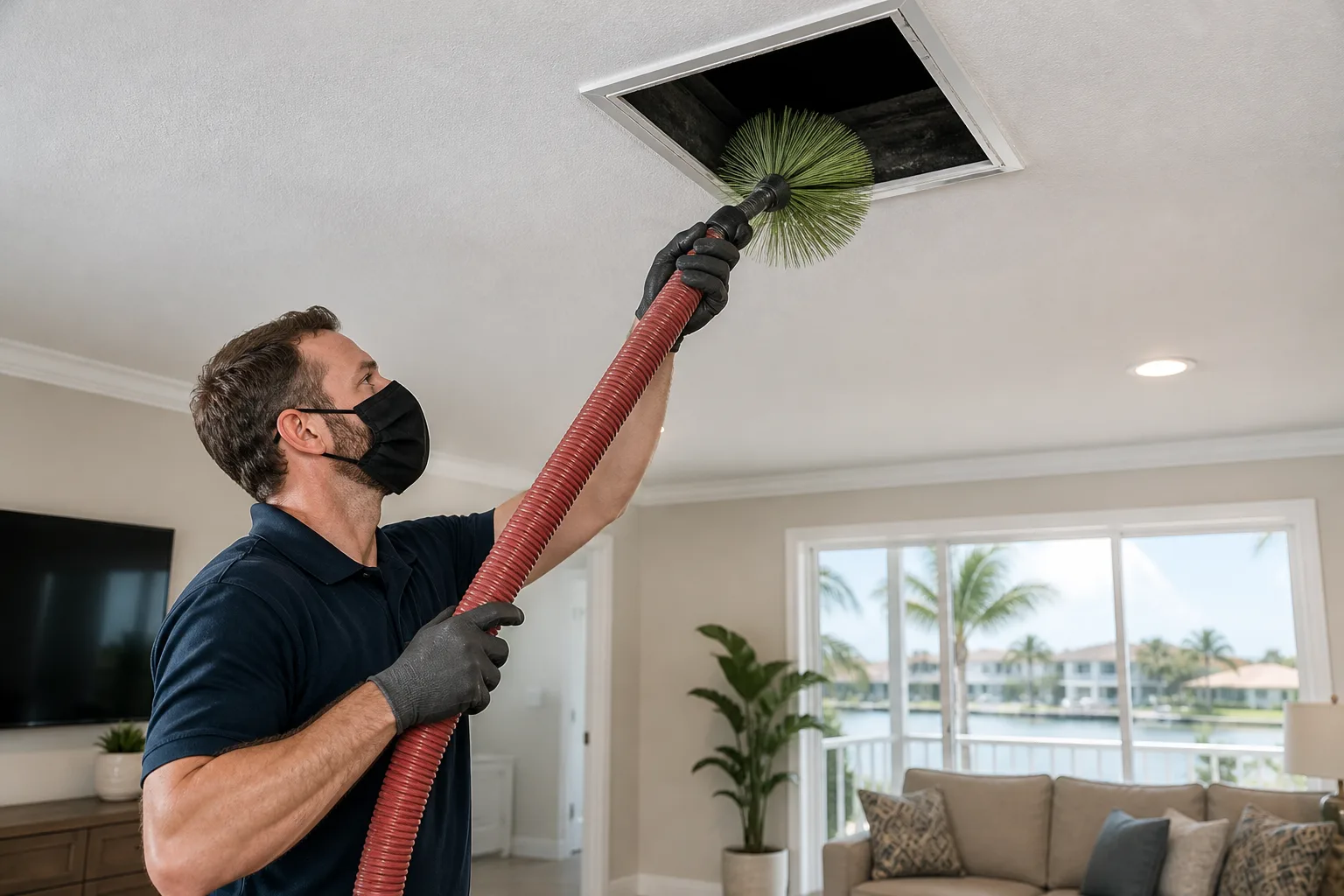
Rotobrush is a contact-based mechanical cleaning system. A flexible rotating brush travels through the duct while a high-powered HEPA vacuum pulls loosened debris out of the system at the same time. The brush does the scrubbing; the vacuum does the removing; both happen in one pass.
Here’s the mechanical breakdown most companies skip over:
- Brush head diameter options. Brush heads come in different sizes, and matching the head to the duct’s interior dimension is the first decision a trained operator makes. An undersized head skips the walls. An oversized one can bind.
- Variable RPM range. Operators adjust brush speed to the duct material and the condition of the debris. Higher RPM on a caked run of metal duct; lower RPM on flex duct where the liner is thin.
- Simultaneous HEPA extraction. The vacuum runs during the entire brush pass, so debris enters containment rather than settling back downstream.
- Camera inspection. A push camera confirms condition before and after the pass. That footage is your proof.
Why does contact cleaning matter so much? Because biofilm and caked debris bond to duct walls. Air-only methods pass over that film the way a leaf blower passes over a dirty sidewalk: it moves the loose stuff and leaves the layer underneath. In a St. Petersburg home where the HVAC runs most of the year, that layer builds faster than homeowners expect.
Why Is Rotobrush Well-Suited to Florida Flex Duct?
Most St. Petersburg homes run flex duct in the attic, and flex duct has a thin inner liner that separates it from insulation. Rotobrush works well here because the operator controls brush speed and head size, which lets a trained technician clean aggressively on metal and carefully on flex. Technique is everything.
Here’s what improper use of any rotating brush system can do to flex duct:
- Tear the inner liner where the brush contacts a sharp transition or a poorly supported run
- Compress insulation by over-pressurizing a sagging section
- Push debris toward a branch takeoff instead of extracting it
The adjustments a careful operator makes on Florida flex: lower RPM, smaller brush heads, slower feed rate through transitions, and camera verification before the brush ever enters a run. We’ve seen what happens when that discipline is skipped, and it usually surfaces as a homeowner calling us to repair ductwork that a cheaper operator damaged. Compared to older Nikro setups and the equipment many St. Petersburg operators still carry, the Rotobrush platform is more controllable on flex because of that RPM range.
If you want the full picture of what our air duct cleaning involves in this city, we’ve laid out the process step by step.
How Can You Verify a Company Is Actually Using Rotobrush?
Ask to see the equipment on the truck when the technician arrives, and ask for camera footage of your ducts before and after the work. A company genuinely running Rotobrush will show you both without hesitation. A company using a shop vac and a claim will get vague.
What the Rotobrush BrushBeast physically looks like: a compact, wheeled unit with a visible brush assembly, a flexible hose and brush shaft that extends into the duct, and a separate HEPA vacuum component. It’s not a wet-dry vac with a hose taped on. Set-up takes real time because the operator is sealing access points, connecting the vacuum, and running a camera before the first brush pass. If a crew is in and out of your home in twenty minutes with no equipment footprint, they didn’t do a contact clean.
What the camera footage should show:
- Before: the true interior of the duct, including the dust film, debris load, and any liner condition issues.
- After: the same run, same angle, with the walls visibly cleared and the liner intact.
- Along the way: the footage should be timestamped or recorded in sequence, not a stock clip.
Ask for both sets before you pay. A technician who did the work will be proud to show it. One who didn’t will change the subject.
What Rotobrush Can’t Do on Its Own
Rotobrush handles the mechanical cleaning. It does not treat microbial growth, seal leaking joints, or correct duct design. Those are separate jobs, and a complete result sometimes requires all of them. Anyone who tells you one process handles everything is selling you a shortcut.
- Mold remediation additives. If the camera shows active biological growth, mechanical cleaning removes the surface but doesn’t address the underlying moisture source or spores. A remediation protocol is a separate conversation.
- UV treatment. UV systems are an IAQ accessory, not a cleaning method. They’re installed at the air handler and coil area, and they work alongside cleaning, not instead of it.
- Duct sealing. Rotobrush will clean a leaking duct run inside and out, but the leaks remain. Sealing is a repair job that happens after cleaning.
- Duct repair. Torn flex liner, disconnected runs, collapsed sections: these need to be repaired, not cleaned around.
This is why our scope includes duct repair alongside cleaning. We clean it, we repair it, we protect it, because cleaning a compromised system and walking away is only half the job. Familiarity with Honeywell and Aprilaire systems matters here too: understanding how the filtration and IAQ accessories integrate with the ducts is part of doing the job right.
What Should You Realistically Expect Before and After?
The debris load and a portion of household odor change immediately. Airflow balance and allergy symptom changes take days to notice, sometimes longer. That’s the honest timeline, and we’d rather set it out clearly than oversell a same-day transformation.
What changes right away:
- The visible debris load in the ducts drops substantially, and the camera footage proves it
- Odors tied to settled dust and debris often drop within the first day
- Return registers look cleaner and stay cleaner longer
What takes days to notice:
- Airflow balance across rooms, which depends on how the system settles after cleaning
- Reduced dust settling on surfaces, which builds over a week or two
- Allergy symptom changes, which vary by household and depend on what else is contributing
A Rotobrush job in a St. Petersburg home is not a one-time fix for a system that needs repair. If the camera shows damaged liner or disconnected runs, expect a repair conversation before you’ll see the full benefit. Our technicians have up to 12 years of experience, and most of what they bring to a job is knowing when to clean, when to repair, and when to say the system needs both.
When to call a pro
Call when you notice visible dust streaking from supply registers, a persistent musty smell that returns after cleaning, or unexplained allergy symptoms that flare whenever the HVAC runs. Call when you’ve bought a home and don’t know the duct history, or when a renovation has left drywall dust in the system. Call if you see any indication that a previous operator damaged the flex duct liner. Those are all worth a professional look, and a free estimate tells you what you actually need.
Related services in St. Petersburg: if your dryer is taking longer to dry clothes, that’s dryer vent cleaning territory, and it’s a fire-prevention job, not a tidiness one.
The Bottom Line
Rotobrush is a contact-based mechanical cleaning system that scrubs duct walls with a rotating brush while a HEPA vacuum extracts debris. In St. Petersburg’s humid climate, that mechanical contact matters because air-only methods don’t remove the film that bonds to the walls. Florida flex duct requires careful technique, so verify the equipment and demand the before-and-after camera footage. Rotobrush handles the cleaning, but mold remediation, UV treatment, duct sealing, and duct repair are separate jobs when the camera shows they’re needed.
For a look at who we are and how we approach a job, see Shield Air Duct Cleaning. And if you’re in St. Petersburg and need help, Shield Air Duct Cleaning offers free estimates. Call (855) 967-4983. We answer 24/7. Fast dispatch from 7am to 7pm, Sunday through Friday.
Frequently Asked Questions
Rotobrush is a contact-based mechanical cleaning system. A rotating brush scrubs duct walls while a HEPA vacuum extracts loosened debris at the same time. It’s different from air-whip or blowout methods, which push air through the duct rather than physically contacting the interior surfaces. If you want an exact quote for your home, call (855) 967-4983 and estimates are free.
Ask to see the equipment on site, and ask for pre- and post-cleaning camera footage of your ducts. The BrushBeast unit is compact and wheeled, with a visible brush assembly and a separate HEPA vacuum. Setup takes real time. If a crew is done in twenty minutes with no equipment footprint and no footage, they didn’t do a contact clean. Call (855) 967-4983 for an estimate and we’ll show you exactly what the process involves.
No. The result depends on brush head selection, RPM, feed rate, and the condition of the duct material. A trained operator adjusts all of these to the system in front of them. On St. Petersburg flex duct, that means lower RPM and smaller heads to protect the liner. Improper use can damage the liner. Call (855) 967-4983 for an honest assessment of what your system needs.
It cleans the duct interior but does not treat active mold growth, seal leaking joints, or repair damaged flex liner. Those are separate jobs, and a complete result sometimes requires cleaning plus remediation, sealing, or duct repair. If the camera shows any of those conditions, we’ll tell you directly. Call (855) 967-4983 for a free estimate on your St. Petersburg home.
Written by the team at Shield Air Duct Cleaning.
Need Air Duct Cleaning Help?
Call Shield Air Duct Cleaning - licensed & insured, with free written estimates in St. Petersburg.
(855) 967-4983